
How We Approach Pest Exclusion for Commercial Food Storage in Timmins
For owners and managers of bakeries, food storage warehouses, restaurants, commercial kitchens and hotels who need building integrity sealed properly, on a deadline.
If a Public Health inspector or a food safety auditor flagged entry points in your facility, you have a deadline. You probably already have a pest control operator on retainer. What you need now is someone who can close every opening properly, document the work, and not slow down your operation while they do it.
That is what we do. We are a construction contractor in Timmins that handles the structural side of pest exclusion: methodical sealing of every gap, crack, penetration and opening that allows pests to enter a commercial food facility. We do not apply pesticides. We close the building.
Here is how we approach the work.
We Start by Walking the Property
Every commercial pest exclusion job starts with an on-site assessment. We walk the perimeter and the interior with you, identify visible entry points, and document what we find before we quote anything. This matters for two reasons.
First, you see what we found before you commit to a scope. There is no selling work that does not need doing, and no missing work that should be in the scope. Second, our notes from the walkthrough go into the written estimate, so when you compare quotes you can see exactly what we are pricing and where.
What we look for during the walkthrough: gaps under and around exterior doors, especially loading bay doors and back-of-house service doors. Penetrations where pipes, conduit and HVAC come through walls and floors. Cracks in foundation walls, especially below grade. Expansion joints in concrete floors. Gaps around grease trap, plumbing and electrical work. Access panels in mechanical rooms. Anywhere the building envelope has been opened up at some point in its life and not closed back properly.
We Use the Right Material for Each Location
This is where attention to detail matters more than any single material. A good pest exclusion job is not about one product. It is about choosing the right one for each location, based on what is around it, how the gap moves, what the surface is, and how the area gets cleaned.
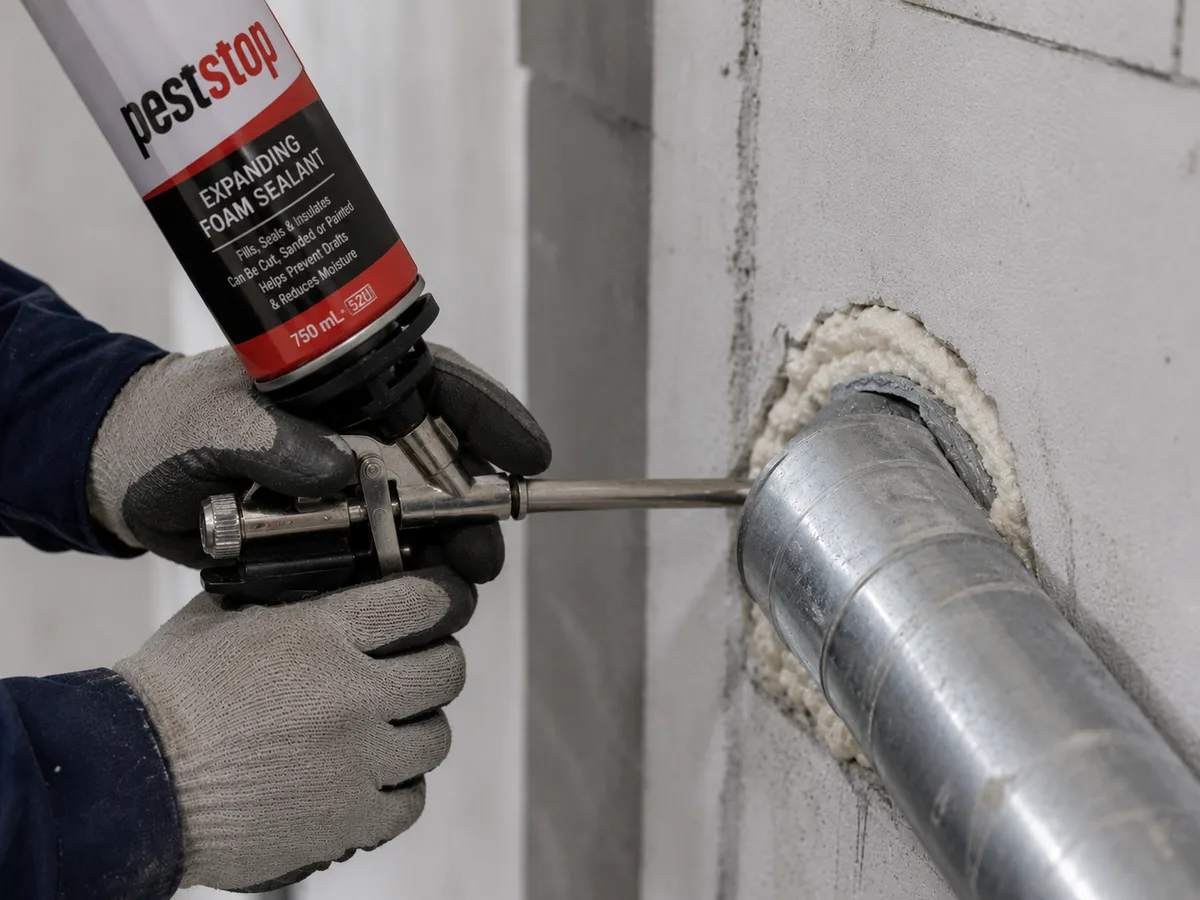
Pest-resistant expanding foam works well around irregular openings such as pipe penetrations and HVAC sleeves, where the foam can fill an awkward gap and stay flexible. For locations where rodents can chew through foam alone, we back the foam with steel or copper mesh in the correct grade so the seal holds for years.
For floor cracks, expansion joints and concrete damage, we use concrete patching compounds appropriate to the floor finish and traffic. For interior walls, trim, around windows and equipment lines, we use silicone and acrylic sealants chosen for adhesion to the substrate and ease of cleaning. Door bottoms get the right sweep or threshold seal for the door type and floor surface.
Every material has a place, and using the wrong one is how exclusion work fails six months later. We carry what we need and pick on site.
We Work Methodically, One Area at a Time
Commercial food facilities cannot have a half-applied job blocking access to walk-in coolers, prep stations or shipping bays for days. We work in zones. One area is fully sealed and cleaned up before we move to the next. That keeps your operation moving and keeps the work visible and reviewable as it progresses.
Scheduling fits your operation. Restaurants and kitchens often need overnight or early-morning work. Warehouses can usually accommodate daytime work in zones that are not active. Hotels need us out of guest rooms by check-in. We plan around your schedule before we start.
We Document Everything for Your Audit File
Every job ends with a written record: what was sealed, where, with what material, on what date. The record goes into your Preventive Control Plan, HACCP records, internal compliance file, or whatever audit framework your facility runs under. If you need photo documentation of specific entry points before and after sealing, we provide that too.
For some clients, this documentation is the whole point. They are sealing because an inspector flagged something, and they need to demonstrate the finding has been addressed. A written record from a contractor, dated, with location detail, is exactly what an auditor or inspector wants to see.
What This Service Is, and What It Is Not
Pest exclusion is structural compliance work. It supports food safety and Public Health compliance by closing the openings that pests use to enter your building. It makes any chemical pest control program you already have far more effective, because the pest control operator has fewer entry sources to monitor.
Pest exclusion is not pest control. We do not apply pesticides, set bait stations or run monitoring programs. That work requires a licensed Pesticide Applicator under the Ontario Ministry of the Environment, and most regulated food facilities are required to have an active pest control program in addition to building integrity. If you do not have a pest control operator and you need one, we can recommend operators in the Timmins area we have seen do good work.
If You Have a Deadline, Tell Us Upfront
Inspection findings come with deadlines. Audits come with prep windows. If you are working against a specific date, say so on the first call. We schedule the assessment within 2 to 5 business days for most jobs, and complete most commercial sealing projects within one to two weeks of approval. Urgent situations can be prioritized.
We carry full commercial liability insurance and WSIB coverage. Certificates can be provided to your office or property management company before work begins.
Need commercial pest exclusion work in Timmins?
We work on bakeries, food storage warehouses, restaurants, commercial kitchens, hotels, retail food stores and food production facilities across Timmins and surrounding communities.
Frequently Asked Questions
Is pest exclusion the same as pest control?
No. Pest control means applying pesticides, setting bait stations or running monitoring programs, and it requires a licensed Pesticide Applicator. Pest exclusion is structural work: sealing the openings that allow pests to enter the building in the first place. Both work together. We do exclusion. Licensed pest control operators do control.
What materials are used for commercial pest exclusion?
It depends on the location. Pest-resistant expanding foam for irregular gaps around pipes and conduit penetrations. Steel or copper mesh in the correct grade for openings where foam alone will not last. Concrete patching compounds for floor and foundation cracks. Silicone and acrylic sealants for interior wall, trim and finish work. Door sweeps and weatherstripping for door bottoms. The right material for each location is what makes the work last.
Do I still need a pest control company if I do exclusion?
Yes, for most regulated food facilities. CFIA Preventive Control Plans and HACCP programs require an active pest control component, not just sealing. Exclusion is what makes the pest control program effective. With good sealing, your pest control operator has less to do and your facility stays compliant with fewer findings on inspections.